
CMO Council Marketing Transformation Mandate
Key Findings from Marketing Leader Self-Assessments of Pivotal, Foundational, and Operational Progress in Applying Martech Innovation to Gaining Business Advantage in the AI Era. More

The Marketing Supply Chain Institute is a dedicated knowledge center focused on benchmark studies, cost audits and competency assessments, best practice development.
Front-line personnel from store managers and field marketing directors to remote location leaders and franchisees, agree that marketing support materials are big contributors to the selling process. But there is still a massive amount of waste and obsolescence due to poor tracking, provisioning and just in time delivery of sales, uniforms, signage and merchandising materials for promotional marketing.
As a result, the Chief Marketing Officer (CMO) Council has undertaken numerous thought leadership studies aimed at assessing the performance of multi-location marketing, demand chain provisioning, campaign fielding, brand execution, promotional logistics and merchandising in the $1.5 trillion marketing services sector.
These initiatives have assessed the effectiveness of spend; procurement processes; agency resource utilization; sourcing, localization and delivery of merchandise/signage/consumables; carbon footprint reductions; workflow and connected vendor management; reduction of waste and cost, and total value delivered to the channel and field.
The linkage between operational marketing effectiveness and brand performance has prompted the CMO Council to form a focused center of excellence, the Marketing Supply Chain Institute (MSCI), designed to drive best practices and thought leadership. The MSCI is a dedicated knowledge center and think tank focused on benchmark studies, cost audits and competency assessments, content aggregation, report publication and syndication, peer-to-peer interactions, best practice development, vertical industry analytics, and global models and frameworks for strategic sourcing and supplier management.
Through the MSCI, The CMO Council has undertaken comprehensive audits to benchmark, analyze and scorecard the state of marketing supply chain management practices. Here are the cost savings, efficiency gains, sustainability benefits, operational controls, risk reductions, and competitive advantages you can achieve through streamlined, AI-infused marketing ecosystem management across major industry verticals. Category sectors, such as Quick Service Restaurants (QSR), as well as banking, investing, insurance, retail, fitness, healthcare, hospitality, and automotive, are ready for MSCM improvement.
A recent Chief Marketing Officer (CMO) Council report, produced in partnership with KPMG LLP, covers critical capabilities of marketing sourcing and how CMOs can enlist procurement to help marketing make better decisions. The report found that CMOs who more actively involve procurement in marketing sourcing enjoy a more positive impact on the overall maturity and quality of marketing sourcing decisions.
The report found that CMOs who more actively involve procurement in marketing sourcing enjoy a more positive impact on the overall maturity and quality of marketing sourcing decisions.
It has been noted that multi-location brand management becomes deeply difficult when brand execution expands faster than the operational infrastructure supporting it. Guidelines, color codes, and visual standards remain essential, but they are only one layer.
Organizations also need comprehensive systems governing exactly how branded materials are selected, sourced, ordered, stored, distributed, and replenished. Without that infrastructure, every single location, department, and program introduces another unmanaged opportunity for inconsistency.
Multi-location marketers maintaining brand consistency at scale ultimately know how to maintain brand consistency. They don’t simply communicate their standards more effectively. They operationalize them.
Areas of investigation and analysis undertaken by the CMO Council Marketing Supply Chain Institute include:
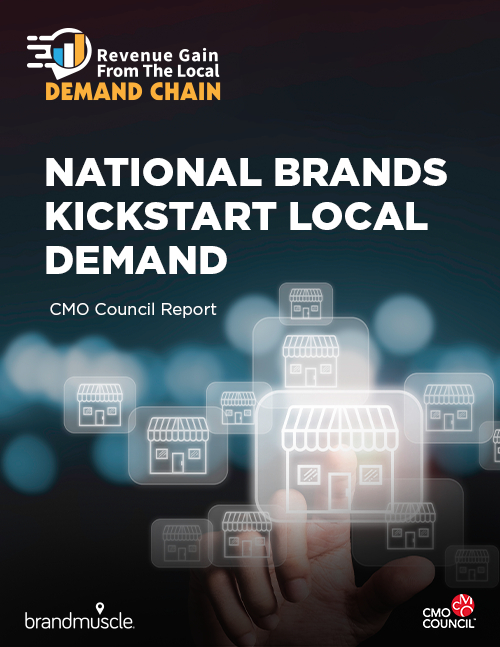
CMO Council research conducted in 2022, in partnership with BrandMuscle, examines the relationship between national brands and their local partner channel networks, including effectiveness, challenges, opportunities, digital marketing tactics, etc ... More
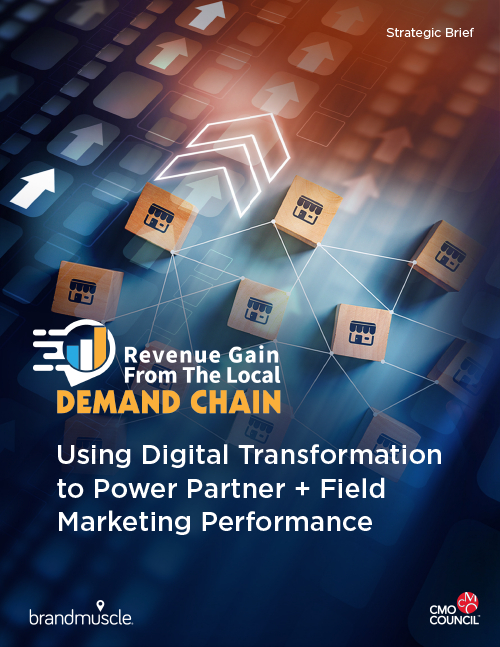
With limited digital marketing resources and expertise, local businesses are falling behind in digital transformation. They need a better understanding of digital marketing tactics such as search, social and online review management — critical ... More
Marketing operational structures may actually be keeping the customer and brand apart. Indeed, global marketers are struggling in a battle between the efficiency of centralization and the effectiveness of localization, causing them to re-think their ... More
This presentation explores background research conducted by the CMO Council and other third party experts to explore the state of adaptability in the world's largest global brands. The presentation explores the localization mandate, benefits of ... More
This white paper details best practices in taking content to market—one that applies supply chain thinking to creative content development and delivery. It also discusses how content fuels the customer journey and, when done correctly, can be d ... More
Go-to-market is a business critical, highly complex, and carefully sequenced process today. However, there can be multiple points of disruption, distress and deficiency in this ecosystem, which is essential to value creation and competitive advantage ... More